Who are NEET Youths
Not in Employment, Education, and Training (NEET) youth are young people aged 15-24years excluded from three systems that create productive opportunities: the labour market, the education system and the skills system. While NEET measures their disconnection from these systems, it covers a broader category of youth vulnerability compared to youth unemployment. First, youth unemployment only captures active job seekers while NEET include the unemployed, discouraged and economically inactive, implying that NEET outnumbers unemployed youth. Figure 1 shows that the youth NEET rate in 2025 was higher than youth unemployment rate in all selected regions, with the highest rates in Arab States (32.4%) and Northern Africa (30.1%) and the lowest in North America (11.8%) while Sub-Saharan Africa (SSA) showed a striking gap (21.6% NEET rate vs. only 8.4% unemployed) indicating many youths are not even seeking work in SSA. Second, rather than just a measure of labour demand as seen for unemployed youth, NEET measures transition failure from education to work. Third, NEET is evidenced to be more stable and comparable across countries compared to unemployment that depends strictly on those actively looking for work. Hence, NEET is justified to be a better measure of the scale of young employment challenge and their vulnerability.
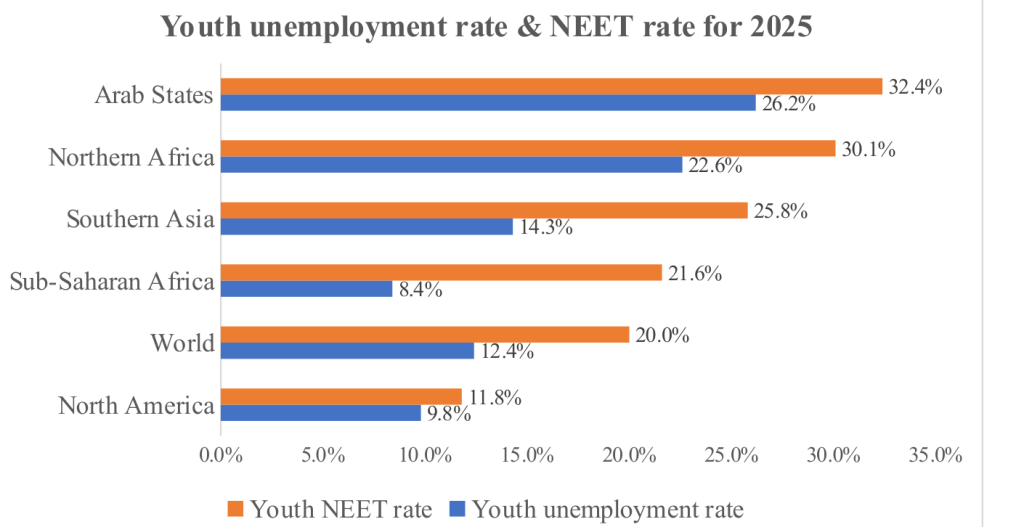
Figure 1: Rates of youth unemployment and NEET in 2025 for selected regions
Source: International Labour Organization. (ILO, 2026). ILOSTAT
Figure 2 depicts the trend analysis of global NEET rate from 2005 to 2025, revealing a decline in total NEET rate from 22.5% in 2005 to 20% in 2025. Women have consistently higher NEET rate and still about double of men, revealing that a persistent gender gap remains. Both the rate and the absolute number spiked sharply in 2020, recording the highest total NEET number before falling again. Despite the falling NEET rate over the period, the absolute number of NEET youth stayed between 245-280 million. This still reveals a high prevalence of NEET youth globally.
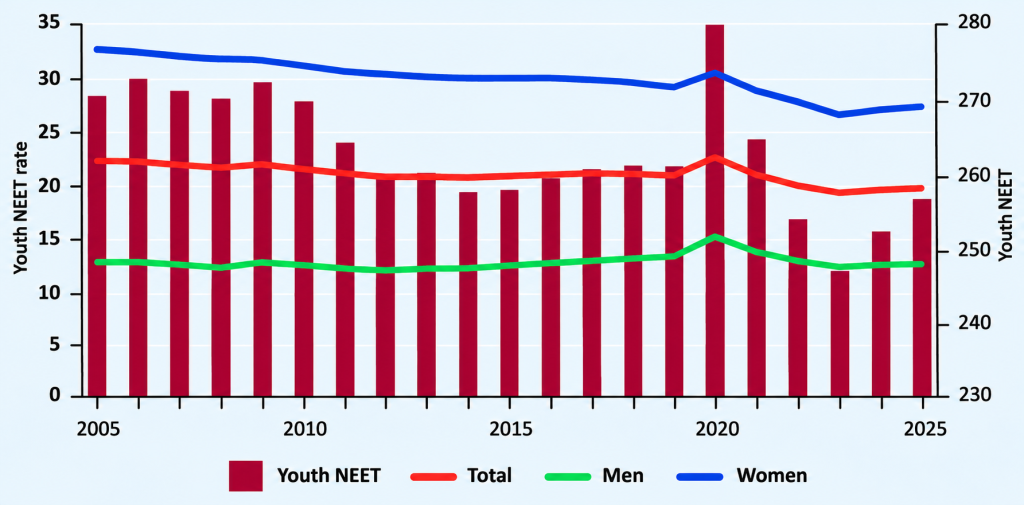
Figure 2: Global youth NEET rate (percentage) and youth NEET rate(million) by sex (2005-2025)
Source: International Labour Organization. (ILO, 2026). ILOSTAT
In low- and middle-income countries (LMICs), due to the youth bulge, high NEET rate is seen as a crisis indicator because it represents a loss of current labour and future generation. NEET has been traced to be concentrated among marginalized people whose exclusions are produced by economic, educational, social and spatial factors. Owing to this, there has been increased policy attention and demands for intersectionality and multidisciplinary response. The Sustainable Development Goal (SDG) 8, target 6, seeks to substantially lower the numbers of youth NEETS, however the prevalence remains high even as we are closer to the end of the United Nation SDG Agenda 2030. Though, the number of young people affected is important for showing the scale of the problem, counting these excluded individuals alone tell us very little about what it means to be NEET. What matters more is what NEET status does to the people directly affected, to their household, to government and to the economy at large. In this discussion, we explore the burden and prevalence of NEET youth in SSA, and, more importantly, the economic costs and consequences of NEET status for individuals, households, government and the economy.
In SSA region, 55.6million of youths are out of employment, education and training in 2025. This accounts for a NEET rate of 21.6% and projected to rise to 58.9million by 2027 (International Labour Organisation, 2026). This indicates the scale of human capital that is not being developed, as these young people are excluded from productive systems where they can acquire new skills and gain more work experiences. However, the opposite is the current state of the LMICs. This signals a potential foregone human capital and forgone demographic dividend, as the growing youth population in SSA is not being converted into productive employment, education and economic growth. The projected increase to 58.9million NEET youth by 2027 demands proactive interventions to prevent further loss of human capital and safeguard the region’s demographic dividend from its youthful population structure.
Cost of being NEET
A clear understanding of who is most affected by NEET is important because the costs are not evenly distributed. It is often concentrated among marginalized young people who face overlapping barriers and disadvantages. Precisely, young women face higher NEET rates due to early marriage, pregnancy, domestic care work and prevailing gender norms while older and rural youth are more at risk during difficult transition from school to work. Also, young people with low education and lack of vocational and digital skills have limited access to decent work. Furthermore, intergenerational disadvantage such as parental poverty has been confirmed to reinforce the NEET pattern as youth from poor households cannot afford schooling and may lack support networks. Within the SSA region, many youths engage in invisible and unprotected work that are not counted in the conventional labour market statistics. The dominance of these informality works further leaves young people to be prone to insecure and low-paying work unable to lift them out of their marginalized situation. Other drivers of NEET are limited digital access, conflict and displacement, disability, climate shocks, skill mismatch and weak labour demand.
NEET prevalence triggers a chain of losses over time, transforming potential economic assets into sustained economic liabilities. Capturing the full extent of this burden, Table 1 shows that NEET youth incur: (i) financial costs (comprising private earning losses and public fiscal losses) and; (ii) non-financial costs (including psychosocial and social costs). Some costs such as mental health and crime have both financial and non-financial costs.
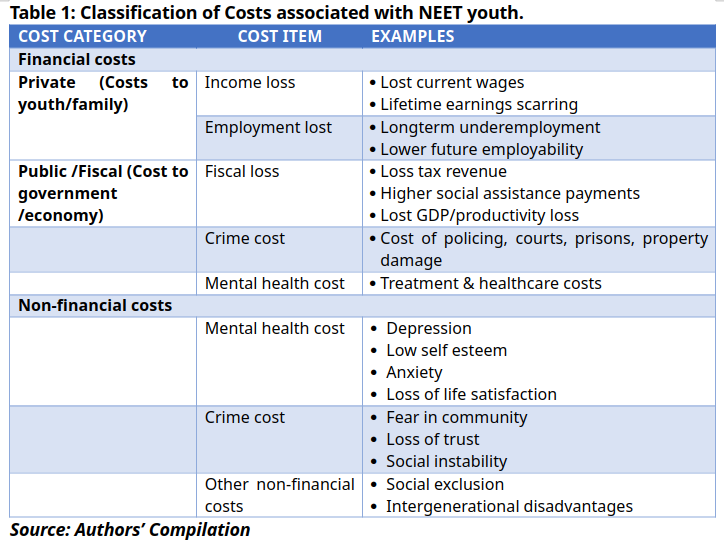
Also, we consider the economic agents that bear these costs (individuals, household, government and the economy).
- For the young NEET, the impact begins with immediate income loss and employment loss, which induce a deeper cost referred to as scarring effect. The scarring manifests through non-financial and mental health costs including skills fade, plummeting self-confidence and psychological distress as well as external rejection when potential employers treat employment gaps as negative signals. Consequently, the temporary exclusion degrades human capital, imposing long-term wage penalties and economic hysteresis, where short term displacement becomes a permanently lower earning path.
- At the household, having a NEET member creates severe financial pressure and emotional strain. It increases the dependency ratio and lowers the support ratio, compelling working adults to absorb the financial costs of supporting them. This drains disposable resources away from other family members and risks reproducing socioeconomic burdens across generations.
- For the government, NEET status creates a double burden combining direct financial losses and elevated social protection costs. On one side, narrowed tax bases diminish public revenue; on the other, public spending escalates due to higher demands for social protection, healthcare services and security measures required to mitigate crime and criminal acts. These dynamic risks create fiscal trap, crowd out crucial public investments in education and infrastructure.
- For the economy, these individuals and institutional drains accumulate into significant structural penalty. The economic cost is reflected in a widened output gap, the difference between potential and actual national GDP compounded by suppressed aggregate demand stemming from the eroded purchasing power of young citizens.
Consequences of NEET
The consequences of NEET status could be short-term or long-term depending on the duration of youth disengagement and the scale of impact (ranging from individual micro-shocks to macro-structural deficits).
- In the short-term, the consequences manifest as acute psychological, behavioural and social disruptions at individual and community levels. Prolonged disengagement serves as an immediate stressor, strongly linked to severe mental health issues such as depression, emotional distress, poor psychological well-being and low self-esteem (Dickens et al., 2020; Theron et al., 2024; Theron et al., 2025). The combination of sudden financial deprivation and lack of structured daily routine frequently leads to an upstick in risky behaviour including crime, insecurity and substance abuse., alongside weakening of social networks and erosion of social capital.
- In the long term, sustained NEET prevalence causes these immediate disruptions to compound into dire macro-economic and generational liabilities. Continuous exclusion results into the following:
- Low human capital development due to the persistent lack of education, training, and workplace skill accumulation.
- At the national level, having a massive cohort of youth who remain economically inactive and unable to develop themselves leads to a chronically low GDP, forcing the economy to operate far below its potential output.
- Over time, this failure to activate youth potential threatens the nation with ‘demographic doom’, where the window to harvest the demographic dividend is permanently lost, turning what should have been an economic driver into a sustained demographic burden.
- The cumulative structural failures trigger severe intergenerational risks, creating a persistent poverty trap where those who are poor today can only transfer poverty to incoming generations.
Policy Options for Solving the NEET Problem
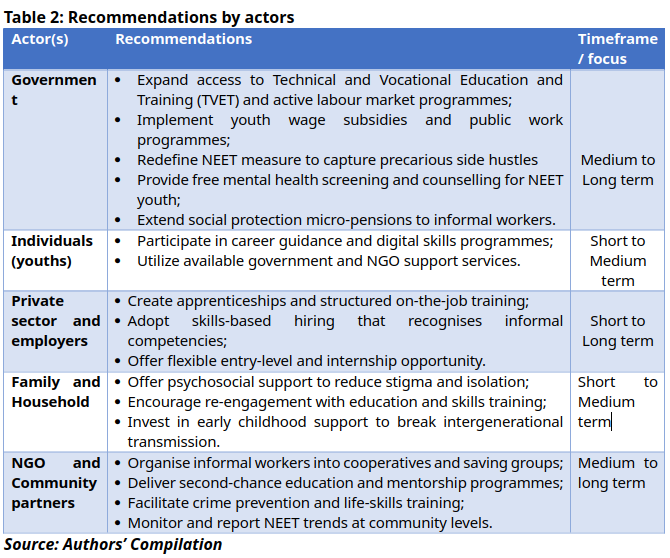
Given that the costs of NEET are multidimensional, affect various economic agents and span both short-term and long-term horizons, effective mitigation requires coordinated interventions by various actors as summarized in Table 2.
Through the RNEET project, our research, youth and community engagements have continued to reflect lived experiences among African NEET youth, showcase patterns and multisystemic resilience-enablers for African youth in Nigeria and South Africa. Using quantitative and qualitative methods, our findings display specific resilience-building interventions to support African youth who are NEET. Our research and contributions help us look beyond describing NEET and their existence in Africa but towards building evidence that can protect young people and their future.
References
Dickens, L., Dickens, L., & Marx, P. (2020). NEET as an outcome for care leavers in South Africa: The case of Girls and Boys Town. Emerging Adulthood, 8(1), 64–72.
International Labour Organization. (2026). Global employment trends for youth 2026: Back to the future. International Labour Office. https://doi.org/10.54394/00033788
Theron, L., Levine, D., & Haffejee, S. (2024). NEET and resilient: Lived experiences of South African emerging adults. International Journal of Psychology, 59(2), 1–13.
Theron, L., Stekel, D. J., Höltge, J., Fawole, O. I., Levine, D. T., Mai-Bornu, Z., Maksudi, K., Olaniyan, O., Wright, C. Y., & Ungar, M. (2025). Factors that affect the resilience of young adults to depression: A systematic review. The Lancet Psychiatry, 12(5), 377–383. https://doi.org/10.1016/S2215-0366(25)00044-6