Dr Omowumi O. Okedare and Prof Olufunmilayo I. Fawole, University of Ibadan
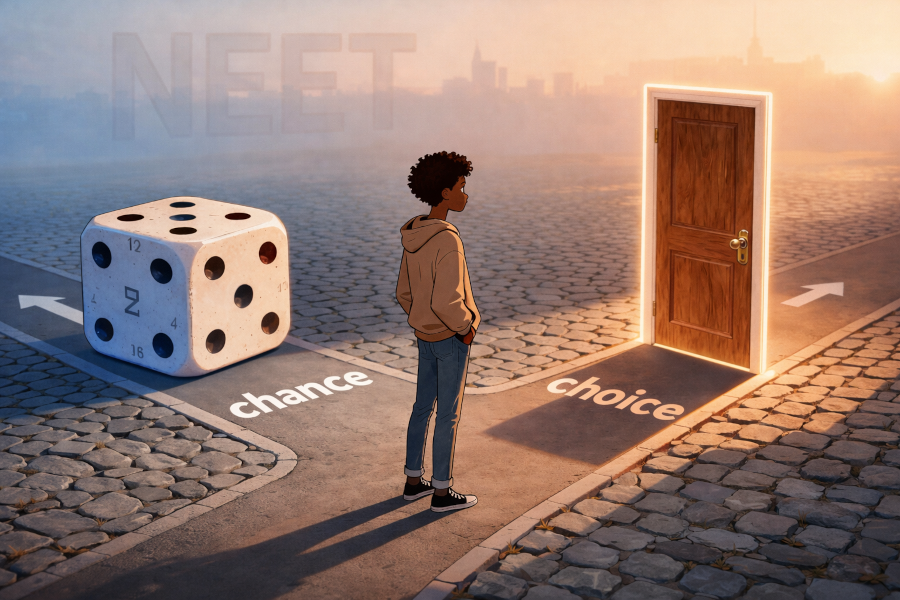
Image made using Canva
Young people who are Not in Education, Employment, or Training (NEET) are often viewed through a narrow lens of personal responsibility. However, the reality is more complex. There is a variety within the NEET population, and individuals enter NEET status through different pathways. Is becoming NEET a matter of chance, or is it a deliberate choice?
NEET by Chance – When circumstances shape outcomes
Human beings are shaped by both nature and nurture. From birth, our environment shapes the opportunities available to us and our future aspirations.
A young person’s place of residence can significantly influence their outlook on life, the opportunities available to them, the social networks they form, and ultimately their career trajectory. Some individuals are born into environments where access to quality education, viable employment, or skills training is limited or absent. Growing up in an urban area with functioning schools, access to digital media, mentorship and job opportunities is entirely different from growing up in a rural area where basic infrastructure is almost non-existent. Individuals in this category are often at greater risk of long-term social exclusion, reduced lifetime earnings, mental health challenges, and exposure to vulnerability-exploitation and gender-based violence.
Parental circumstances also play a critical role. Children raised in households where one or both parents experience long-term or recurring unemployment may be more likely to follow similar paths. Such children may struggle to complete their education, lack motivation or guidance to actively seek employment, or have limited exposure to training opportunities. This dynamic can perpetuate an intergenerational cycle of poverty.
Young people without a complete education, limited career options and minimal training opportunities are more likely to become NEET. Thus, being NEET is more than a personal failure; it is also about structural disadvantages.
NEET by Choice – When withdrawal becomes a response
In contexts where formal and informal employment opportunities are scarce, a prolonged job search can lead to frustration and discouragement. After repeated unsuccessful attempts, some young people may withdraw from active job seeking, training programmes, or productive engagement within their communities. What may appear as a “choice” can sometimes be a response to discouragement, low self-efficacy, or a perceived lack of viable options.
In other cases, some individuals, especially females, may consciously decide to pause education, employment or training for personal reasons — such as childbirth, caregiving responsibilities, pursuing alternative paths, or reassessing career goals. However, these decisions are often shaped by broader economic and social realities rather than purely individual preference. Taking a longer break than necessary may limit re-entry into the employment space or training.
Psychological dimension of NEET
Being NEET has significant consequences for a young person's psychology. Prolonged inactivity hampers self-esteem, social identity and mental health. Youth NEET often face stigma and discrimination from members of society because of a lack of productivity. Stigma could further cause isolation and withdrawal and consequently impair mental health. Ultimately, what started as a structural disadvantage could lead to social exclusion and worsening mental health.
Conclusion
The question of whether NEET status is by chance or by choice does not have a simple answer. For many young people, structural inequalities, family background, and economic conditions heavily influence outcomes. What may seem like a personal choice is often deeply rooted in circumstance. Addressing NEET effectively, therefore, requires not only changing individual behaviour but also tackling the systemic barriers that limit opportunity.
Recognising whether NEET status occurs by choice or chance is important for policy and program design. Choice (voluntary) NEET may require career guidance and flexible training pathways, while Chance (involuntary) NEET situations demand structural interventions such as job creation, inclusive education policies, social protection, and targeted skills-development programs.
References
- Fabrizi, E., & Rocca, A. (2024). “NEET status duration and socio-economic background”. Socio-Economic Planning Sciences, Volume 95. https://doi.org/10.1016/j.seps.2024.101986.
- Zuccotti, C. V., & O’Reilly, J. (2018). Ethnicity, Gender and Household Effects on Becoming NEET: An Intersectional Analysis. Work, Employment and Society, 33(3), 351-373. https://doi.org/10.1177/0950017017738945.
- Rahmani, H., Groot, W., & Rahmani, A.M. (2024). Unravelling the NEET phenomenon: a systematic literature review and meta-analysis of risk factors for youth not in education, employment, or training. International Journal of Adolescence and Youth, 29:1, 2331576, DOI: 10.1080/02673843.2024.2331576