Michael Ungar, PhD
All over the world, a generation of young adults are in the precarious situation of not being able to launch themselves into independence. In economically more precarious parts of the world there are simply far too many youth for the small number of education and employment opportunities available. In their case, they have few choices that are within their control to make. The impact on mental health is likely to be severe and long-lasting. The social consequences of a lost generation will be a legacy that inhibits personal development, economic growth and democracy for years to come.
In Western, Educated, Industrialized, Rich and Democratic (WEIRD) countries, though, there is also a large number of NEET. By some estimates that number is as high as 12% in countries like Canada and the U.S. The impact on mental health is known. Higher rates of depression, loneliness and anxiety are typical. Some youth are more at risk than others. Those who were already at risk of mental health problems during adolescence are even more susceptible to mental health issues becoming chronic when they are NEET as emerging adults.
The solution, though, can look very different depending where one is growing up. In countries with precarious economies, there are no easy solutions other than schemes to support entrepreneurship, financial support to help young people go on to postsecondary education, and of course a need for businesses and governments to respond with entry level internships.
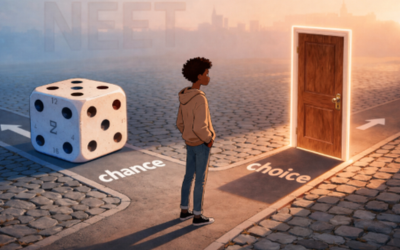
In WEIRD countries, artificial intelligence is eviscerating entry level employment opportunities. Combine this with young people’s expectations for fulfilling careers in fields like computing science, finance, the arts and medicine, and one quickly sees that there are never going to be enough opportunities for young people to get a foothold in their chosen careers (of these only computing science is still increasing job possibilities though for more and more experienced workers). Ironically, there are plenty of jobs in WEIRD countries that need people. The trades like carpentry, plumbing, solar panel installation are begging for employees. So too are many of the helping professions like long-term care support for elderly, and of course nursing. All to say, these positions don’t hold the same appeal, it seems, as being doctors, lawyers and architects (or social media influencers). The result is a mismatch between career opportunities and young people’ expectations. Add to this an already heightened level of mental health distress in young people following the recent pandemic, and one has an impossible situation that is leaving many youth on the sidelines.
My point here is that there may really be two kinds of NEET. Like so much of what we now understand about resilience, context matters. A protective factor must be contextually relevant. What a NEET in sub-Saharan Africa needs will be quite different from what a Canadian youth needs. What is the same, however, is the impact that being NEET has on mental health. That is a concern that every country should share and a problem that will require outreach to keep young people’s hopes alive and mental health safe.
References:
LMI Insights Report no. 17 (August, 2019). Finding Their Path: What Youth Not In Employment, Education or Training (NEET) Want.
https://lmic-cimt.ca/publications-all/lmi-insights-report-no-17-finding-their-path-what-youth-not-in-employment-education-or-training-neet-want/
Veldman, K., van Zon, S. K. R., & Bültmann, U. (2024). Once in NEET, always in NEET? Childhood and adolescent risk factors for different NEET patterns. European Journal of Public Health, 34(3), 505–510. https://doi.org/10.1093/eurpub/ckae025
Willhardt, G., Klehe, U., & Scharfer, M. (2025). Setting Sails for Your Harbor: Navigating Beyond NEET Status Through Self-Efficacy and Career Decidedness. Journal of Adolescence. https://doi.org/10.1002/jad.70051